Introduction
At first when considering motivation seriously, I thought motivated individuals possessed something I lacked. It appeared they were naturally quite energetic, disciplined, highly focused, and very sure about their objectives. Meanwhile, I frequently found myself really wanting to enhance my existence yet struggled greatly with maintaining consistent work ethic for extended periods. I really felt enthusiastic about a target for a couple of days – perhaps several weeks – however, after the initial thrill faded away, things got significantly harder all at once. I’d put off starting until later, get sidetracked easily, or rationalize beginning anew the next day.
For a rather long period of time, I took this as a personal failing. I believed I was just never a highly motivated individual. That notion really demotivated me greatly since it created the impression that motivation was something I either naturally had or didn’t have at all – rather than an ability I could develop over time.
After a while, I discovered that motivation isn’t some sort of enigmatic energy set aside for those extremely driven folks. Rather, it’s usually the outcome of well-defined targets, quite significant reasons, little daily activities, helpful habits, and seeing real-life proof that we’re making progress indeed. I didn’t have to suddenly wake up one morning feeling totally different all at once. I really had to establish certain conditions that made moving forward slightly easier.
As soon as I grasped this concept, motivation became infinitely less daunting. I ceased expecting a strong emotional spark and began concentrating on very basic behaviors that helped generate momentum. In this post, I aim to share the easy-to-learn lessons which really helped me start building motivation from scratch myself.
Table of Contents
Starting With One Clear Reason
The very first blunder I ever made was attempting to motivate myself – all without really grasping why I even wanted to change things. I’d pick out targets just because they appeared appealing at first glance. I yearned to work out more often, read even more books, earn a lot more cash, get way more done, and develop some better daily habits. However, there was one major issue here: these objectives were very unclear and emotionally quite feeble. Once exercising became really tough, I didn’t have any deeper motivations powerful enough to propel me forward.
I finally discovered that motivation gets a whole lot simpler once you attach your objective to something that holds great personal significance. Rather than saying “I should really start exercising,” I remind myself that I desire far more energy, significantly improved health, and a lot more faith in my capacity to manage my life myself. That motivation truly resonates more strongly since it relates the action directly to an actual benefit I hold dear.
I also started to see that my motivation doesn’t necessarily have to sound super impressive to other people. It simply has to hold importance for me alone. Perhaps I need to establish financial stability since I’m so sick of constantly worrying about money. Or maybe I’d love to pick up a new skillset because I crave way more flexibility in my profession. Or perhaps I’d prefer to enhance my sleep patterns since I’m utterly drained each morning – starting every day without much energy.
These highly personal reasons give me lots of emotional drive. Each time motivation starts waning, I go back to asking myself, ‘What’s the real point behind this?’ If I can’t articulate a clear response, then I know the goal either isn’t significant enough – or perhaps it really needs redefining itself.

Making the First Step Almost Too Easy
Another really pivotal lesson for me was figuring out how to make that initial step ridiculously tiny. In the past, I believed motivation demanded quite bold moves. When I wanted to get fit, I would devise very demanding exercise plans. To read more, I’d set myself the goal of reading an enormous amount each day. And if I sought to be more productive, I created rather intricate timetables. My plans looked very ambitious indeed – yet they frequently fell short since they asked so much energy before I’d even started building any consistent habits. Ultimately, I came to understand that newbies require momentum far more than high-intensity effort.
Nowadays I opt for actions that truly feel almost a bit too effortless. I might go for a ten-minute walk, read about five pages, focus on a task for fifteen minutes, or clean just a very small area – as opposed to the whole room all at once. These activities might seem utterly insignificant – but they greatly reduce my resistance levels. As soon as I get moving, I usually carry on way longer than intended because getting started is normally the biggest hurdle by far.
Even when I don’t keep going, I actually still succeed because I’ve met the commitment I made with myself. This builds my self-assurance quite considerably. With time, those little victories build up and turn even bigger tasks into something much less daunting. Motivation really tends to appear after you’ve begun acting, rather than beforehand.
Building Consistency Before Chasing Big Results
For quite some time, I determined my motivation by what I managed to accomplish over a very brief period indeed. When I’d have an extremely productive day, I really did feel quite successful. However, whenever I slowed down a bit, I thought I must be falling behind – losing all my hard-earned progress. My way of thinking thus created this extremely tiring pattern of massive effort followed by utter exhaustion. I finally figured out that consistency counts so much more than those rare occasions of high motivation itself.
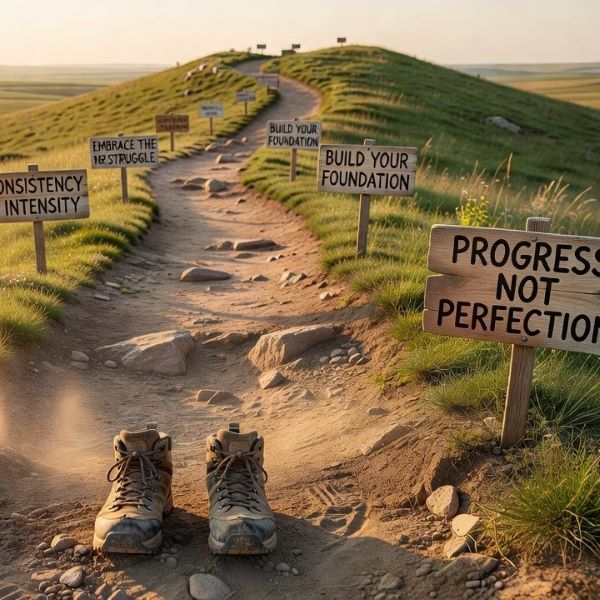
I began concentrating on simply showing up rather than trying to do things flawlessly all the time. If my aim was writing, I actually wanted to put some words down fairly regularly. And if my target was exercising, I desired movement to become a regular aspect of my schedule each week. Making this switch greatly reduced the stress levels since achieving success became something I got to experience almost every day instead of looking forward to it from far off in the distant future. Consistency also greatly helped me build my sense of identity itself.
Designing My Environment to Support Motivation
At first, I really didn’t get just how much my surroundings were shaping my actions – I sort of took it for granted that my motivation would be powerful enough to conquer all obstacles. Really though, continually battling my environment exhausted me – a lot more than necessary. When my phone sat right next to me while I tried working, I looked at it. And if there was an easy supply of unhealthy food around, I was much more prone to eat it.
I started making some pretty basic changes myself. I moved temptations further away, got everything ready ahead of time, and kept healthy options right in front of me – and very easy to grab. If I wanted to read, I put a book in plain view. If I planned to exercise early in the morning, I laid out my clothes the evening before.
These little adjustments might seem almost insignificant – yet they significantly decreased the amount of thinking I had to do in the heat of the moment. My motivation became ever so much more dependable when my environment actually lent a hand. Rather than having to ask myself to be incredibly brave each and every day, I created a space that really made starting the task that much less difficult indeed.
Using Progress as Fuel
One of the most effective motivators I’ve discovered is tangible progress itself. Whenever I can observe proof that my work is paying off, I naturally desire to keep going. However, the issue lies in the fact that numerous significant objectives yield results very slowly indeed. If I concentrate solely on major outcomes, I may feel quite disheartened well before the actual results really show themselves. That’s why I began monitoring some of the smaller manifestations of progress instead.
I might document how many days I successfully maintained a routine, how many pages I’d read, how much money I had managed to save, or how regularly I exercised. These very simple entries really remind me that my efforts are piling up – even when the ultimate goal continues to seem far away indeed. They also assist me in noticing improvements that my mind might forget about altogether. Without recording, I usually end up focusing all my attention on what’s still lacking. With recording, I get to see just what I’ve actually accomplished so far. This creates a sensation of movement – and movement generates lots of motivation.

Learning What to Do When Motivation Disappears
One of my greatest breakthroughs was acknowledging that motivation would vanish at times. I used to see very little motivation as a signal to give up. If I wasn’t highly inspired, I really believed I’d lost interest – or perhaps there was even something wrong. Eventually, I came to understand that motivation itself is an emotion – and just like all other emotions, they change quite frequently. I could still get things done even if that emotional drive was nowhere to be found.
On tough days, I set the bar lower instead of calling off the plan altogether. If I usually exercised for half an hour, I might do just ten. If I normally spent an hour working on a project, I might commit to only fifteen minutes. The real aim was holding onto the sequence of events more so than performing at my absolute best. This method has truly saved me from giving up numerous times since it keeps me from letting one particularly low-energy day turn into an entire week of inactivity.
Avoiding the Comparison Trap
Another significant hurdle for newbies is comparing themselves to others. I would look at individuals who’d been very disciplined, highly successful, or very skilled – and compare their current state to where I’d just started out. This really often left me feeling way behind schedule. I had forgotten that what I was seeing was the end result of many years of work – rather than the initial stages of their path. Evaluating my first week against someone else’s fifth year wasn’t exactly fair – yet I did it all too frequently.
After a while, I got better at using comparison more thoughtfully. Rather than wondering if I measured up to another individual, I started asking if I was getting better compared to myself from before. This truly made making progress seem a lot more realistic. I also ceased from presuming that obvious achievements told the complete picture. Very rarely do we get to see all the errors, setbacks, or quiet years of hard work that happened before someone reached their current status.

Turning Motivation Into Identity
My motivation really shifted gears when I stopped focusing on goals all the time – starting to think about identity itself. Goals have their use, yet they ultimately run out. Identity keeps going. Rather than saying “I really want to read 10 books,” I began considering “I’d like to develop into someone who continually learns.” As opposed to saying “I’ll work out for 3 months,” I started thinking “I’d like to develop into someone who prioritizes their health.” This mind-set change really made my actions seem even more purposeful – each and every minor action became proof of the person I was developing into.
I discovered too that an identity really forms a more enduring basis for motivation – far beyond external rewards alone. Whenever I see myself as quite disciplined, curious, trustworthy, or very health-conscious, I naturally really want to act in ways supporting that identity. Of course, it doesn’t just click right away. Identity really gets built up through repeated actions. Each time I actually do follow through, I’m casting another ballot for the kind of person I aspire to be.
Conclusion
Learning how to construct motivation from scratch really showed me that I didn’t have to suddenly turn into a totally different individual overnight. I really needed very clear reasons, quite manageable actions, consistent habits, actual visible progress, and an environment that truly supported the life I wanted to create. The largest transformation occurred when I stopped expecting motivation to magically show up before even getting started. I started taking those initial small steps first – and then allowed motivation to develop based on the fact that I was actually making progress. That really made the whole process seem much more down-to-earth and less enigmatic.
I also discovered that newbies’ motivation is incredibly delicate – and that’s perfectly normal. It really requires shielding from overly ambitious goals, extreme self-criticism, comparisons, and the notion that each day must be incredibly inspiring. As time went by, those little actions generated momentum, momentum built my confidence, and my confidence created a significantly greater drive. I don’t require constant motivation to alter my life. I just need a bit of motivation to start the next somewhat useful task. When I keep doing that over and over again, I eventually build something far more dependable than fleeting enthusiasm – trust in myself. And once I trust myself to continually show up, motivation becomes so much simpler to hold onto.
FAQs
Q1: What’s the simplest way to get started on building our motivation?
A1: For me, the easiest place to begin is picking out just one significant goal – then break down that very first step into something really tiny. Achieving our initial goals builds momentum – and also decreases that dreaded fear of failing.
Q2: Ought I really wait till I actually feel motivated to get going?
A2: Absolutely not! I’ve discovered that motivation quite frequently shows up right after we start trying. Taking that little initial action will even generate some much-needed emotional energy to keep us going further along the way.
Q3: Why does motivation disappear all too quickly for me?
A3: It really happens a lot because the target is too vast, the plan is just too intense, or the true reason behind my goal isn’t strong enough itself. Really simplifying things can be super helpful here.
Q4: How can I remain consistent when just starting out?
A4: I concentrate on doing a few smaller tasks every day that I know I can carry out regularly. Consistency gets a whole lot simpler when you focus on building a new habit that truly feels very doable, rather than an absolute challenge all the time.
Q5: What should I actually do when motivation is running low?
A5: I take a look at what I’m expecting from myself and significantly decrease those expectations – yet I still attempt to hold onto the habit. Sometimes taking a slightly smaller step helps preserve momentum – and keeps us moving forward even when we’re feeling less motivated today.
Q6: How can I finally put an end to constantly comparing myself with others who seem more successful?
A6: I tell myself that what I see now is probably their present state – not where they ever began. I redirect my focus more towards asking myself if I’m making progress compared to how far I used to go. My personal past is where my real benchmark lies!
Q7: Is tracking my progress really worth it for maintaining motivation?
A7: Indeed! Seeing actual progress gives me all sorts of proof that all my efforts are paying off, no matter how small the result might seem. This really makes it a whole lot simpler to keep going even if progress isn’t always immediately noticeable.
Q8: What is basically the key takeaway for beginners looking to improve their motivation skills?
A8: Really, the number one thing to remember is that I don’t have to feel extremely motivated beforehand to even get started. Doing lots of little actions consistently really creates a foundation for developing much stronger motivation – plus greater self-control and overall confidence in the long run.